
See How Easily You Can Rebuild the Friendship
Your Marriage Was Built On...

If You Still Want the Marriage to Work, You Can Learn to Feel Close Again...

Did You Know Many Distressed Couples Wait Six Years Before Reaching Out for Help?
Six years of sleeping beside each other while feeling miles apart.
Six years of carefully choosing words, swallowing feelings, replaying arguments and telling friends, family and children that everything is fine.
According to the Gottman Institute, couples often wait approximately six years after serious relationship distress begins before seeking couples therapy.
There’s more.
Relationship experts offer this sobering warning:
“It’s not the couple that argues that’s in trouble. It’s the silence that’s destructive.”
That silence does not always look dangerous.
Sometimes it looks like two people sitting on the same sofa while staring at different screens.
It looks like conversations about groceries, work schedules, school activities and bills—but never about the marriage.
It looks like a kiss goodbye that has become automatic.
It looks like lying in the same bed while one person quietly wonders whether the other would even notice if they stopped trying

And research suggests marital stress can affect more than emotional happiness. It may influence cardiovascular, endocrine and immune functioning, while higher-quality marriages have been associated with better health outcomes.
But Now There’s Good News…
There is a different way to think about rebuilding closeness.
One that does not begin by deciding which spouse is right, which spouse is wrong or who started the latest argument.
It begins by uncovering the painful pattern both people have become trapped inside.
It recognizes that criticism may be protecting a fear of being ignored.
Silence may be protecting a fear of making things worse.
Defensiveness may be protecting a person who already feels like a disappointment.
And anger may be covering a much softer sentence neither spouse feels safe enough to say:
“I still need to know that I matter to you.”
This clinically grounded approach combines the behavioral science of the Gottman Method, the deeper relational insights of Imago Therapy and the Akan principle of Sankofa—the wisdom that sometimes you must return and retrieve what was left behind before you can move forward with strength.
It offers a new path toward emotional connection, one built on understanding the nervous system, recognizing unconscious relationship patterns and learning how to repair the moments that once pushed two loving people farther apart.
Instead of Living Like Roommates Who Share Responsibilities…
Instead of coming home and immediately bracing yourself for the next complaint, cold response or uncomfortable silence, imagine no longer having to study your spouse’s face before deciding whether it is safe to speak.
Instead of eating dinner while discussing children, deadlines and household problems, only to realize that neither of you has asked the other a meaningful question in weeks, imagine finally understanding why the smallest conversation can feel so emotionally dangerous.

Instead of lying awake beside your spouse replaying what you should have said, imagine putting your head on the pillow without a tight chest, racing thoughts or that familiar ache of feeling alone beside the person who promised you would never have to be.
Instead of having the same fight wearing a different set of clothes—money on Monday, parenting on Wednesday and intimacy on Saturday—imagine recognizing the hidden wound beneath all three.
The problem may be that every attempt to protect yourselves has slowly taught your partner to stay away.
One spouse pushes because being ignored feels unbearable.
The other withdraws because being criticized feels unbearable.
The harder one reaches, the farther the other retreats.
Eventually, both people feel abandoned.
Starting Today You Can Begin Seeing the Marriage Differently
You can imagine a hard conversation that doesn’t end with a slammed door or one of you on the sofa.
You can see anger as information, withdrawal as overwhelm instead of proof your spouse stopped caring.
You can replace “You are the problem” with “We are caught in a painful pattern.”
Picture coming home without your body bracing at the door. Picture your children watching two adults disagree, pause, listen and repair.
That future doesn’t begin when work slows down or the children grow older. It begins when the pattern is finally seen clearly enough to interrupt.

Important Message You Receive All Year
Consider it carefully.
Read it more than once.
Then decide whether this is what married dual-career couples, overextended parents and emotionally disconnected spouses have quietly been searching for.
The Fix for Living in the Same House but Feeling Completely Alone

I’m Denise Cagle, LCSW, MSW, founder of Sankofa Harmony Therapy.
Two decades of couples and family therapy, including work inside healthcare’s highest-stakes environments, twice recognized with the I CARE Award.
My method didn’t come from training alone. It came from a relationship I almost didn’t survive.
You can’t repair deep disconnection with memorized phrases while the nervous system braces for rejection.
Real reconnection goes deeper. It shows each person what the conflict has been protecting, and what opens up when it isn’t needed anymore.
The goal was never to stop arguing. It was to feel safe, heard, and close enough to look across the room and think:
“This is still my person.”
Today, the blueprint I use to help couples name that pattern.
One that…
Helps You Speak Honestly Without Turning
Another Conversation Into a Fight
And makes the process about as clear, practical and emotionally safe as humanly possible.
After more than two decades with couples, I stopped listening to what they argued about and studied what happened underneath. Why one spouse got louder while the other went quiet. Why apologies never lasted.
What surprised me: couples who rebuild connection don’t have fewer disagreements. They recognize what’s happening beneath them.
Research associated with the Gottman Method found distressed couples respond positively to bids for connection just 33% of the time, compared with 86% among successful couples.
A question. A touch. A sigh. Each one is an invitation to come closer — or another moment when someone learns not to reach again.

The Pattern Hiding Beneath the Argument
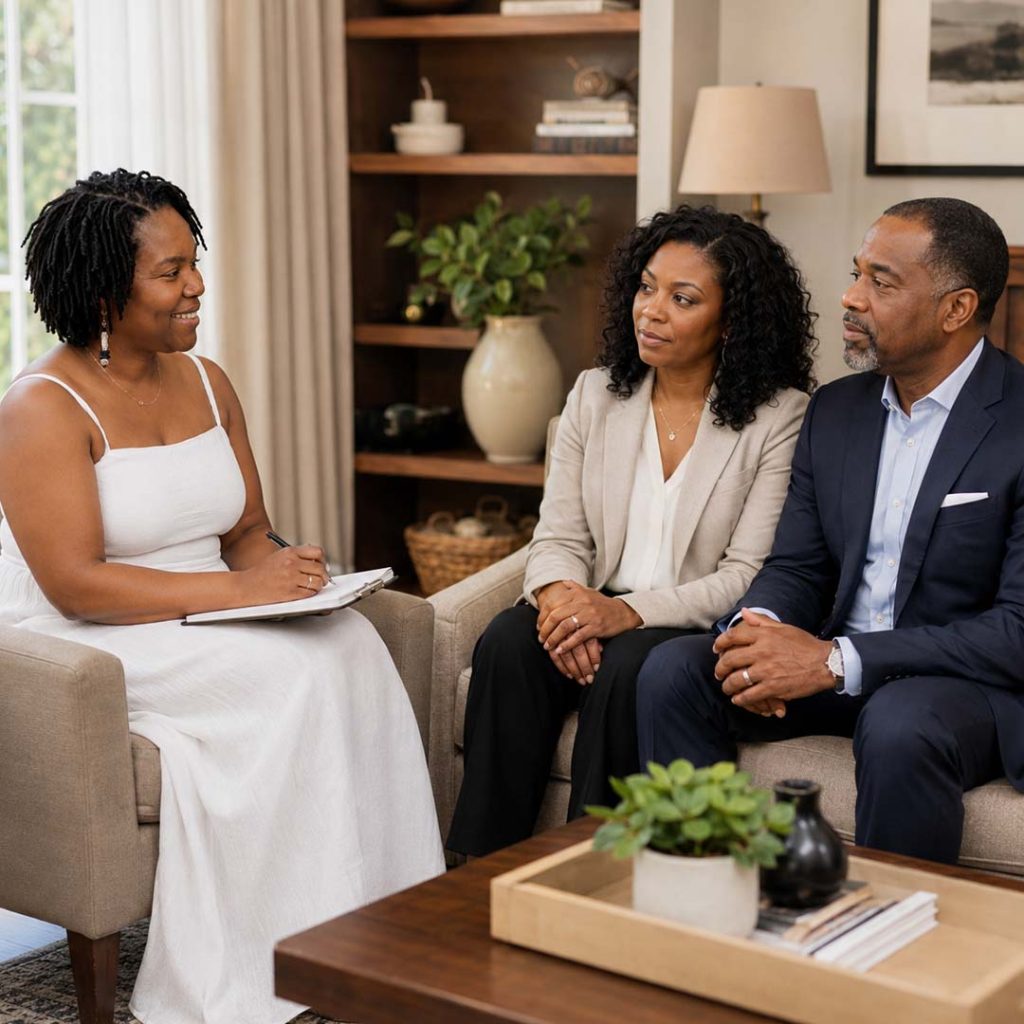
Most couples believe the problem is whatever they argued about last. The dishes. The children. Money.
But those are only the doorway. Beneath them sits a quieter question. One spouse asks, “Do I matter to you?” The other asks, “Will I ever be enough?”
Neither is ever said out loud. It surfaces as criticism, defensiveness or silence, while the real fear stays hidden.
One pursues harder to avoid abandonment. The other pulls away to avoid failure. Together they create the very loneliness each is trying to escape — and the ways they learned to protect themselves now block the love they still want.
So I built a simple, by-the-numbers guide for naming that cycle and finding the path back to each other.
And It Works Without Blame or Forced Conversations

Most disconnected couples won’t reopen every old wound or sit through another conversation where one feels attacked and the other ignored. So this doesn’t rely on blame or forced confessions.
When a couple is already raw, another “serious talk” feels less like healing and more like walking barefoot across broken glass.
One explains. The other hears criticism. One pushes harder. The other goes quiet. Soon they aren’t discussing Tuesday night — they’re defending their entire history.
Research shows persistent conflict activates attachment fears, and links demand-withdraw patterns, where one partner pressures while the other retreats, to declining relationship satisfaction.
So instead of forcing the conversation, you slow the cycle down and uncover the fear hiding beneath the words.
Studies link stronger emotion regulation and constructive communication to greater marital satisfaction, and find that one partner’s difficulty regulating emotion affects both.
Then you can look across the table and see the frightened person beneath the anger, and hear “I miss you” instead of “You never do anything right.”
Gottman research calls these moments bids for connection. In a six-year follow-up of newlyweds, couples who stayed married had turned toward those bids far more often than those who divorced.
So instead of sleeping in the same bed and privately feeling alone, you begin feeling close, understood and safe.
All You Have To Do Is Break the Pattern Together

That’s it.
Instead of waiting for life to slow down, you pause the cycle and hear what your spouse is actually trying to say. Right before dinner. Right before bed. Right before the conversation that usually ends with one of you shut down.
No more rehearsing your opening sentence on the drive home, changing it three times, still feeling your stomach tighten at the door. No more swallowing what you feel to keep the peace.
You bring up the bills without fighting about respect. Talk about the children without attacking each other’s parenting. Come home without bracing for tension.
And you show your children what love looks like when two people disagree, listen, repair, and try again.
Most of all, you feel like husband and wife again. Not two exhausted adults managing schedules, bills, and a marriage neither of you knows how to reach.
Then one morning you notice something is different.
The room is quiet, but not cold.
One of you makes coffee while the other leans against the counter. A small joke about who forgot the creamer. A hand brushes a shoulder. The children are hunting for shoes, the calendar is still full — but for a few seconds you feel like a team again.
Not perfect. Not finished. Just closer.
Close enough to look at the person beside you and think:
“This is still my person.”
That’s what awaits you inside…
Sankofa Harmony Therapy
Understand the Pattern, Heal the Wound, and Rebuild the Connection
Most couples try to fix the present without understanding the past.
The ancient Akan word Sankofa means:
“Go back and fetch it.”
You cannot move forward until you retrieve what was left behind. That is the hidden engine inside this work.
Weaving together the Gottman Method, Imago Therapy, and the principle of Sankofa, it reaches all three layers of a struggling relationship — the patterns you repeat, the wounds you carry, and the roots that shaped you before you ever met.
Other therapy focuses on the latest argument. This examines the architecture beneath it.

Sankofa Harmony Therapy features…
The Gottman-Based Repair Toolkit
Practical moves for softening how you start, interrupting the damage mid-argument, and answering the small reaches you’ve been missing.
So rather than waiting until it’s too loud and too personal to stop… you get to feel the turn coming. A pause. A softer sentence. A hand on a shoulder — and the fight doesn’t become one more scar you carry to bed.
The Imago Connection Dialogue
A structured way for one of you to speak while the other simply receives — no correcting, no defending, no loading the rebuttal.
So rather than saying it louder, adding more examples, watching your spouse’s face go flat… you get to hear “I understand why that hurt you” and know it’s true. Your words finally have somewhere to land.
The Sankofa Retrieval Process
Together you go back — gently — for the wounds and unmet needs still steering the marriage, and bring home what was left behind.
So rather than reopening old wounds to prove who bled more… you get to understand why one sentence still lands like a slap, and why your spouse sometimes answers today from inside something that happened decades ago
The Difficult Conversation Blueprint
A structure for money, intimacy, parenting, trust, and family boundaries — so one hard topic stays one topic.
So rather than raising a single concern and ending up on trial for everything since 2017… you get to stay with the real issue. The budget without attacking character. Intimacy without shame. The children without either of you feeling like a failure.
The Intimacy Without Pressure Process
Desire, rejection, resentment, and touch — talked about openly, so closeness stops being a test one of you keeps failing.
So rather than lying inches apart, both wondering whether reaching over means rejection or obligation… you get to rebuild warmth slowly. A hug that lasts longer. A hand resting on a leg with nothing owed. Touch that says “I’m glad you’re here” again.
The New Relationship Rituals Plan
Marriages rarely end in one moment. They thin out across a thousand missed ones. You’ll build small rituals that hold a place for each other.
So rather than letting work, children, bills, and exhaustion take every inch… you get moments that belong only to the two of you. A morning check-in. A goodbye kiss that isn’t automatic. A private joke. A touch that says “we’re still here.”
And much more...
Here is just a fraction of what youwill receive inside
- A clearer understanding of why the same arguments keep repeating
- A practical way to recognize emotional triggers before they take control
- Tools for speaking honestly without blame or criticism
- Support creating emotional safety for both partners
- Strategies for reducing defensiveness and withdrawal
- A framework for rebuilding friendship and affection
- Guidance for repairing trust through consistent action
- A healthier approach to intimacy and vulnerability
- Tools for becoming more united as parents
- A process for replacing resentment with understanding
- A clearer path toward reconnection, commitment, and hope
This is not about creating a marriage where no one ever disagrees.
It is about creating a marriage where disagreement no longer has the power to make two loving people feel like enemies.
It is about helping you look across the room, recognize the person beneath the pain, and quietly feel:
This is still my person.
Here's What To Do Next...
Pay In Full
$1,297
Make one investment of $1,297 and reserve all six sessions for the lowest cost.
Flex Pay
$245
Spread your investment across six convenient weekly installments of $245 per session.
That’s it. No surprise charges. No hidden fees. No wondering what costs extra.
You receive six private, 90-minute deep-dive sessions over 12 weeks, with intentional space between meetings to apply what you learn and return with real experiences.
My goal is to help couples move beyond arguing, withdrawing, and quietly feeling alone under the same roof — and rebuild the closeness your marriage has been missing.
You might be asking “Do I take insurance?” For years I did, but not for this program.
Here’s Why…
Insurance requires a diagnosis code, which means your file has to say something is clinically wrong with you or your marriage.
Most couples I work with aren’t disordered. They’re disconnected. Your relationship shouldn’t need a diagnosis to justify getting help, and I don’t want a claims department dictating how many sessions you’re allowed or what lands in a permanent medical record.
Paying directly keeps the room private, and yours.
Click the button below and select the payment option that feels right for you.
That Said:
Time Is Of The Essence
The Connection Gap rarely stays the same. It quietly grows.
On the drive home when neither of you says what you’re thinking. When one spouse reaches, gets a distracted response, and decides not to try again.
And life rarely gets less hectic on its own. Another deadline. Another school event. Another month while two good people get better at running a household and less certain how to reach each other.
Every week you understand the pattern sooner is another week you can respond differently.
Six Deep-Dive Relationship Sessions
Ninety minutes gives you room to move past surface conversation, instead of unpacking years of hurt and leaving just as the truth surfaces.
One session may reveal why money becomes an argument about respect. Another, why one pursues while the other shuts down.
Not to assign blame, but to see the pattern clearly enough to stop treating each other like the enemy.


Twelve Weeks of Supported Momentum
The space between sessions is not empty time. It is where understanding becomes behavior.
Time to try a different opening sentence. To notice your body preparing for conflict. To answer a bid you might have missed.
Then you return with real moments, not theories.
A $245 First-Session Risk-Free Experience
You should not have to commit before knowing what working together feels like.
Attend the first 90-minute session in full, then decide. Notify Denise before the second session that it is not the right fit, and all unused sessions from a pay-in-full investment are refunded. On Flex Pay, all future installments are canceled immediately. You pay only for the session you attended.
This is how it all starts…
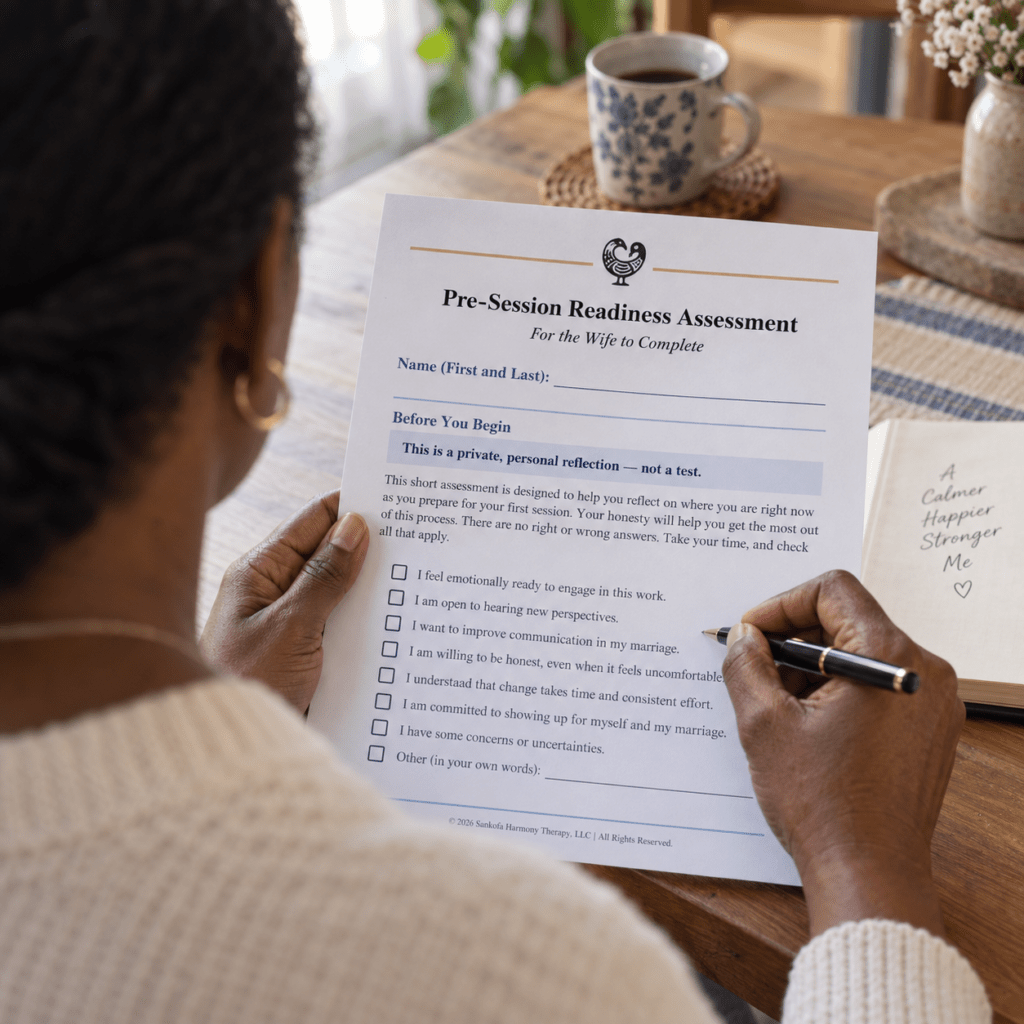
First, Complete Your Private Assessments
Before you speak a single word together, you both get room to breathe. Each spouse completes a separate, private assessment, about 10 minutes.
No comparing answers. No softening the truth because your spouse is watching your face.
One may admit:
“I feel like I am the only one still trying.”
The other:
“I still care, but I no longer know how to talk without feeling attacked.”
Both matter.

Then, Join Me for a Complimentary 20-Minute Zoom Call
Then we meet for a complimentary 20-minute Zoom conversation. Not a therapy session — a fit-and-clarity conversation: what appears to be creating the distance, what you both want, and whether this is the right support.
Most importantly, we identify the first practical step toward interrupting the pattern that has kept you feeling more like roommates than husband and wife.
Click the Link Below to Begin
Complete the private assessment as honestly as you can, then select a time for your Zoom call.
Because each couple receives individual attention, only a limited number of openings are available at one time.
When you believe your marriage is worth understanding, begin below.
And You'll Be Joining Other Couples Who Refused to Keep Pretending
Couples often begin after years inside the same contradiction.
Successful in public. Disconnected in private. Affectionate in photographs. Silent on the ride home.
Capable of managing careers, children, and everyone else’s needs — but no longer sure how to have one honest conversation.
Your story does not have to end with two people preserving the house, the lifestyle, and the photograph while privately losing the relationship those things were built to support.

Frequently Asked Questions
Most couples therapy focuses on the argument sitting on the surface.
Sankofa Harmony Therapy goes beneath it.
It helps you understand the repeated pattern, the old wound underneath the reaction, and the emotional fear each person is trying to protect.
That means the work is not simply about learning how to communicate better.
It is about understanding why one spouse pushes harder, why the other shuts down, and why the same painful cycle keeps returning even when both people promise to do better.
By combining principles from the Gottman Method, Imago Therapy, and the Akan wisdom of Sankofa, the process helps couples go back, retrieve what was left unresolved, and use that understanding to build a healthier future together.
No.
Many couples begin this work long before divorce papers are on the table.
They may still love each other deeply, but feel more like roommates, coworkers, or co-parents than husband and wife.
They may manage the children, the bills, the schedules, and the household well while privately feeling lonely inside the marriage.
Sankofa Harmony Therapy is for couples who want the relationship to work but no longer know how to reach each other without triggering another fight, shutdown, or rejection.
You do not have to wait until the marriage is in crisis to begin repairing the distance.
That belief is common.
When couples have been hurting for a long time, each person naturally begins collecting evidence that proves the other person caused the distance.
Sankofa Harmony Therapy does not begin by placing one spouse on trial.
The focus is on the painful cycle between you.
One spouse may criticize because they feel ignored.
The other may withdraw because they feel attacked.
The criticism creates more withdrawal.
The withdrawal creates more criticism.
Instead of asking, Who is the problem? The work asks, What pattern has taken control of this marriage?
That shift alone can lower defensiveness and make honest conversation safer.
A previous experience does not automatically predict this one.
Some couples leave therapy feeling as though they talked about the same problems week after week without understanding why those problems kept returning.
Others felt rushed, blamed, or unable to get beneath the latest disagreement.
Sankofa Harmony Therapy is structured to help identify the architecture beneath the conflict.
The work examines emotional triggers, protective reactions, old wounds, repeated patterns, and the moments where connection breaks down.
The goal is not to keep describing the fire.
It is to locate what keeps striking the match.
Couples often need time to move beyond the rehearsed version of the problem.
During a shorter session, one spouse may finally begin speaking honestly just as the appointment is ending.
That can leave both people emotionally activated and then sent home without enough time to process or repair.
A 90-minute session creates room to hear both perspectives, slow down the cycle, uncover what is beneath the words, and help the conversation land more safely.
It allows the work to go deeper without feeling as though every meaningful moment is competing with the clock.
Insurance commonly requires treatment to be connected to a diagnosable mental-health condition.
But many couples are not seeking help because one spouse is mentally ill.
They are seeking help because the relationship has become emotionally distant, tense, lonely, or stuck in a painful pattern.
Sankofa Harmony Therapy focuses on the relationship itself rather than assigning one spouse the role of the identified patient.
Private payment also allows the structure, length, and direction of treatment to be based on the couple’s needs rather than an insurer’s rules about diagnosis, session duration, medical necessity, or continued authorization.
It can also reduce the amount of sensitive relationship information shared with a third-party payer.
Insurance plans and out-of-network benefits vary, so couples may still choose to contact their insurer directly about possible reimbursement.
The experience includes six private, 90-minute sessions held every two weeks.
Each session gives you focused time to understand what is happening between you and what needs to change.
The space between sessions allows you to apply what you are learning in real life.
You may practice bringing up a difficult subject differently.
You may notice the moment your body prepares for conflict.
You may catch the pursue-and-withdraw cycle before it consumes the evening.
You may respond to a small bid for connection that you would have missed before.
Then you return with real moments to examine, refine, and build upon.
The goal is not insight that stays in the therapy room.
The goal is change you can feel at the kitchen table, in the car, during bedtime, and inside the conversations that once felt impossible.
You do not have to arrive with certainty.
Many couples begin therapy caught between hope and exhaustion.
One spouse may be ready to repair the relationship while the other is afraid to hope again.
The process can help both of you understand what has happened, what each person still wants, what meaningful repair would require, and whether both partners are willing to participate.
The goal is not to pressure you into a predetermined decision.
It is to replace confusion, guessing, and emotional fog with greater honesty and clarity.
Sometimes the first meaningful step is not knowing the final answer.
It is finally understanding the real question.
That is one of the main reasons couples seek this kind of support.
You may begin the conversation intending to discuss one issue, but within minutes you are defending your character, bringing up old mistakes, raising your voice, or shutting down completely.
Sankofa Harmony Therapy helps slow that process down.
You learn to recognize the trigger before the reaction takes over.
You begin hearing the softer message beneath the sharp words.
You learn how to express pain without turning it into an attack and how to listen without immediately preparing a defense.
The goal is not to avoid difficult conversations.
It is to make those conversations safer, clearer, and less destructive.
The first session is protected by a risk-free policy.
You can attend the full initial 90-minute session and experience the process for yourself.
You can see how the conversation is guided, whether both partners feel respected, and whether the approach feels appropriate for your relationship.
When you decide before the second session that continuing is not the right fit, all unused sessions from a pay-in-full investment will be refunded.
And if you’ve selected the bi-weekly payment option, future installments will be canceled.
You pay only for the first session you completed.
That gives you the opportunity to begin without feeling trapped inside a 12-week commitment before you know whether the fit is right.
Disclaimer:
Every couple’s path is their own, and no therapist can promise a particular outcome. What happens in these twelve weeks depends on what both of you are willing to bring to it — the honesty, the practice between sessions, the willingness to stay in the room when it gets hard. Sankofa Harmony Therapy offers structure, insight, and a safe place to do that work, but the work itself belongs to you. Results are not guaranteed, and the stories shared here reflect individual experiences rather than a promise of what yours will be.
